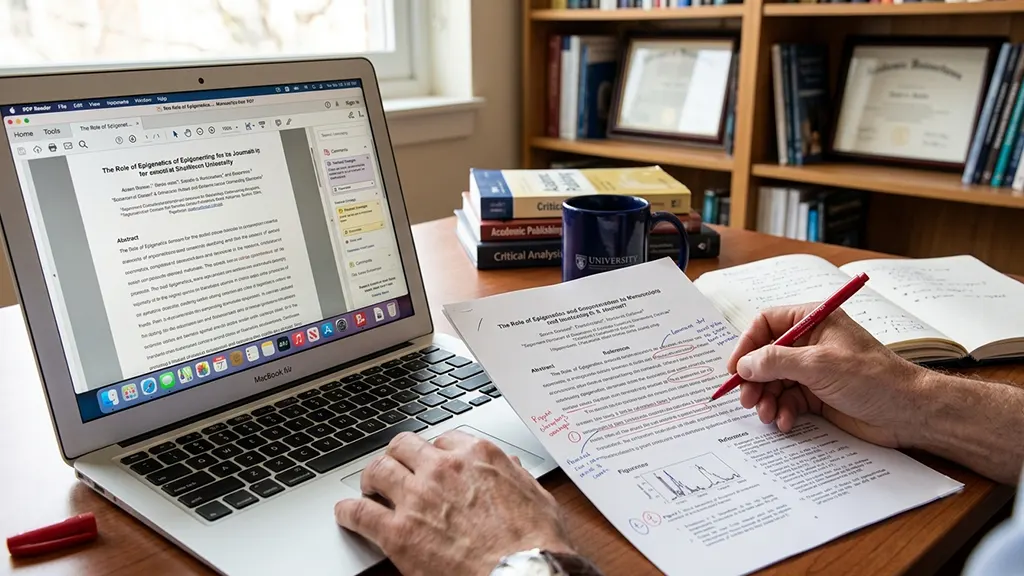
Academic publishing relies heavily on the proper functioning and reliability of peer review process for academic journals. Each published paper has typically been reviewed by scholars with a detailed knowledge of the relevant subject area to decide its quality, originality, accuracy and relevance before being read by the public. This process is useful for upholding the standards of research, quality of scientific publications, and the validity of published results.
If you have recently been invited to review a research paper, you may be wondering how to review a manuscript professionally and fairly. Peer reviewing is more than simply identifying errors. It needs critical thinking, constructive feedback and ethical responsibility. A well written review can not only help in the editorial decision making process, it can also be of help to the author in improving the publication.
This guide details each step of the process of manuscript review from accepting the invitation right through to providing a detailed review report.
Why Peer Review Matters in Academic Publishing
Peer reviews serve as a way of checking the quality of scholarly journals. The editors depend on the reviewers to help them determine whether a manuscript will provide important knowledge to the field and whether it will be academically acceptable for publication in the journal.
Doing a thorough review can help:
- Improve the clarity and accuracy of research.
- Identify methodological weaknesses.
- Detect ethical concerns.
- Check and confirm that conclusions are backed up by evidence.
- Make suggestions for revision prior to publication.
While reviewers help editors with publication decisions, their main role is to give reviews which are balanced, objective and constructive and helpful to editors as well as authors.
Pre-Review Checklist
If you receive an invitation for a review, spend a bit of time determining if you are the right person to do the job. By following the journal reviewer guidelines, one will have a fair and efficient review process.
1. Assess Your Expertise
Question yourself if you know anything about the manuscript. You don't have to know all of the aspects of the paper but you need to know enough about paper's methodology, subject area, and research context that you can make meaningful comments.
If the paper is not in your area of specialty, it's best to turn it down right away.
2. Confirm You Can Meet the Deadline
Typically, reviewers have 2–4 weeks to provide a report to a journal. Don't accept unless you are able to carefully evaluate and respond to the invitation within a reasonable period of time.
Late review causes delay in publication and is inconvenient to the editor and author.
3. Review for Conflicts of Interest
Do not consult manuscripts if you have a personal, financial, or professional relationship that might affect your judgement.
Examples include:
- Involving the authors in collaboration recently
- Employing the same institution
- Competing research interests
- Financial relationships arising from the study
If you see that there is a conflict, notify the editor at once.
4. Maintain Confidentiality
Keep in mind that manuscripts are confidential documents that are under review. Do not copy, publish, or talk to others about unpublished research without permission from the journal.
First Reading: Understand the Big Picture
The first reading should be one in which you are trying to comprehend the manuscript, not analyse each and every detail.
At this point, ask questions like:
- Which is the research question addressed in the paper?
- Is the subject matter topical and relevant?
- Is there something new to be added from the study?
- The objectives are well formulated?
- Does the manuscript have a logical organization?
Don't give too many details at first. Rather, make some general observations and select parts to be read more carefully in your second reading.
A brief overview enables you to familiarize yourself with the author's overall argument before assessing each element. You can also hire a professional peer reviewer to assist you.
Second Reading: Evaluate Every Section Carefully
A much more detailed evaluation is needed for the second reading. That is when many scientific manuscript review tips come in very handy.
Evaluate the Introduction
The introduction should:
- Explain the research problem clearly.
- Review relevant literature.
- Identify knowledge gaps.
- Clearly state the objective(s) or hypothesis.
Review if the authors have referenced current and relevant research.
Examine the Methodology
The methodology can be the determining factor in whether or not the research results will be reliable.
Consider:
- Does the study design seem to be appropriate?
- Do methods of participant selection/selection criteria made sense?
- Is there sufficient sample size?
- Is it okay to use statistical analyses?
- Would it be possible for another person to conduct the study?
If key methodological information is lacking, state specifically.
Review the Results
The results section should provide results in a straightforward manner, avoiding unnecessary interpretation.
Check whether:
- Tables and figures have been properly labeled.
- Data are consistent with written description.
- Statistical analyses are appropriate.
- Results are answers to the research questions.
Be alert for inconsistencies between the reported data and the conclusions.
Assess the Discussion
The discussion should be factual and provide an understanding of the findings.
Ask yourself:
- Are there conclusions that can be drawn from the data?
- Have restrictions been recognised?
- Is previous research compared to findings?
- Do suggestions for future research are indicated?
The authors should not go beyond the evidence and make claims.
Consider Ethical Standards
One aspect of knowing how to review a manuscript is ethical compliance.
Identify signs of:
- Approval from relevant committees.
- Consent of participants as necessary.
- Data integrity.
- Proper reporting standards.
- Funding sources and conflicts of interest.
Any moral issues should be emphasized to the editor.
Publish Your Research Successfully Right Now!
Gulf Journal Publishers are now offering their world-class publishing services to scholars around the world to help them publish seamlessly!
Contact Us Now!
How to Write a Peer Review Report?
Knowing how to write a peer review report is just as important as evaluating the manuscript itself.
A good review should be organized, courteous, and readable to editors and the author.
Start with a short summary of the paper to show an understanding of the study.
For example:
“This manuscript examines the effectiveness of a new intervention to increase patient outcomes. The topic is relevant and the study fills an important gap in the existing literature.”
Then organise your comments into separate sections.
Major Revisions
Identify problems that have a major impact on the quality of the manuscript.
Examples include:
- Weak study design
- Insufficient statistical analysis
- Missing methodological details
- Unsupported conclusions
- Ethical concerns
- Important missing literature
Describe the importance of each concern and offer solutions to make it better.
Minor Revisions
These comments are provided to clarify the research but do not alter its validity.
Examples include:
- Grammar corrections
- Formatting inconsistencies
- Figure improvements
- Reference updates
- Typographical errors
- Sentence clarity
Comments with numbering makes it easy for authors to respond.
Confidential Notes for the Editor
Most journals offer a section where you can submit anonymously, to editors' eyes only.
Here you may discuss:
- Concerns about originality
- Ethical issues
- Suspected plagiarism
- Publication recommendations
- Overall confidence in the study
Try not to add new scientific criticisms here that authors can't respond to.
Best Practices for Writing Constructive Feedback
Professional reviewers aim to enhance the manuscript, not to criticise the author.
Good feedback will be:
- Specific rather than general.
- Objective rather than emotional.
- Respectful throughout.
- Evidence-based.
Instead of writing:
"The approach used is inadequate."
Write:
"The manuscript could use more information about how participants were recruited and/or sample size calculation, for better reproducibility."
Positive language enhances the chances of getting published authors to successfully revise.
Common Mistakes New Reviewers Should Avoid
The first-time reviewers make mistakes without realizing it, which diminishes the value of their assessment.
Avoid:
- Paying attention exclusively to grammatical matters.
- Giving very short reviews.
- Requesting unnecessary experiments.
- Giving in to prejudice when forming a judgment.
- Missing ethical concerns.
- Writing negative or disparaging remarks.
- Failure to follow the guidelines provided by the reviewers for the Journal..
A balanced review highlights both strengths and weaknesses.
Conclusion
Effective manuscript review is a skill that needs to be refined over time, but all reviews help to make for better academic publishing. Reviewers can assist editors and researchers when they follow the guidelines for journal reviewers, carefully evaluate each part of the paper and prepare a clear, constructive report.
Keep in mind also that it is not your job to recommend acceptance or rejection but to help the quality, accuracy and integrity of scholarly work. Well-considered reviews can enhance the overall peer review process for academic journals, favoring authors, journals, and the research community as a whole.
Frequently Asked Questions
1. What is the aim of peer review in journals?
Peer review checks the quality, originality, accuracy and significance of research prior to publication to ensure high standards of academic work.
2. How to recognize a good invitation for a manuscript review
Consider only if it is related to your area of expertise, your time availability, and no conflicts of interest.
3. What is the maximum length of a peer review report?
This will differ in length depending but most reviews are between 500-1500 words in length depending on the complexity of the manuscript.
4. Will I correct grammar in a manuscript review?
“Yes, but” – pay attention to the scientific quality, methodology, clarity and validity of the scientific work, not just language errors.
5. What should be the content of major revision comments?
Major revisions should focus upon issues that impact upon the validity of the study, including research design, data analysis, missing information, or conclusions that are not supported.
6. Can reviewers recommend rejecting a manuscript?
Yes. Reviewer(s) may submit rejection recommendation with detailed comments, when the research has significant deficiencies or fails to meet the journal's standards.
7. Where do confidential comments to the editor go?
Private notes for reviewers where reviewers can discuss ethical issues, suspected plagiarism, publication recommendations, or other sensitive issues not intended for the authors.
8. How to be constructive with writers?
Be respectful, specific, objective and solution focused. Describe every concern explicitly and discuss some practical steps to improve.