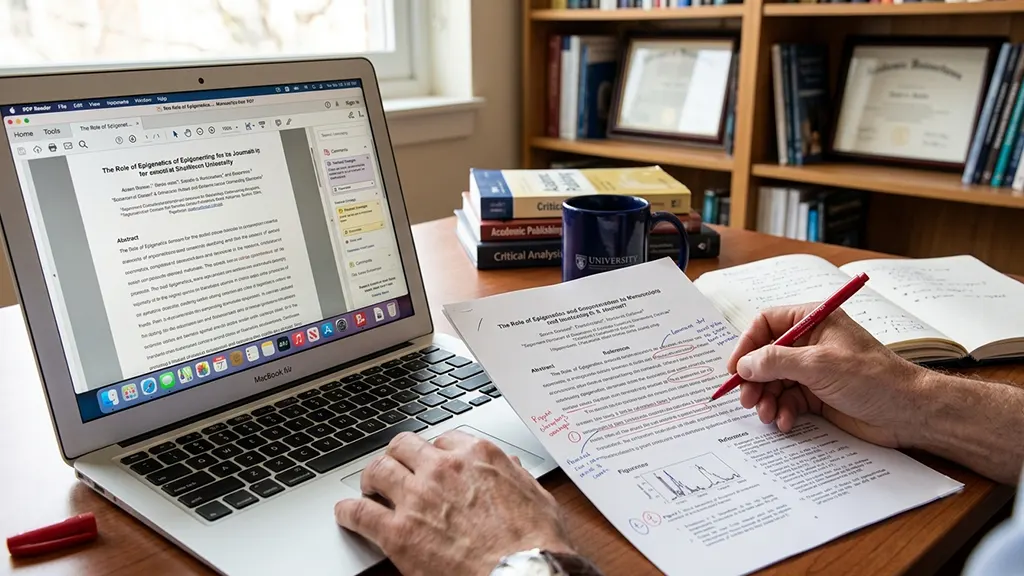
Peer review is essential to academic publishing and research. It serves as a quality-control method to ensure academic publications meet strict criteria for importance, validity, and correctness.
But navigating the peer review process might be intimidating for researchers and new journal editors. However, it is also essential to their professional development.
The impartial evaluation of your research article by professionals in your area is known as peer review. This process assesses a paper's quality and suitability for publication.
To preserve the high standards of academic communication and the calibre of specific journals, peer review is essential.
Researchers who write publications also benefit greatly from it. As a result, Journal Peer Review is essential to the research process that it is difficult to envision a world without it.
This guide talks about the Academic Peer Review process in detail
Understanding Peer Review Process
The peer review process is a critical component of academic publishing, as it ensures that research is thoroughly evaluated before being disseminated in the scientific community.
Further, scientific peer review is often criticized by experts. But it is necessary in order to maintain the quality and integrity of published works.
How does the peer review process work?
Here is How does the peer review process work.
-
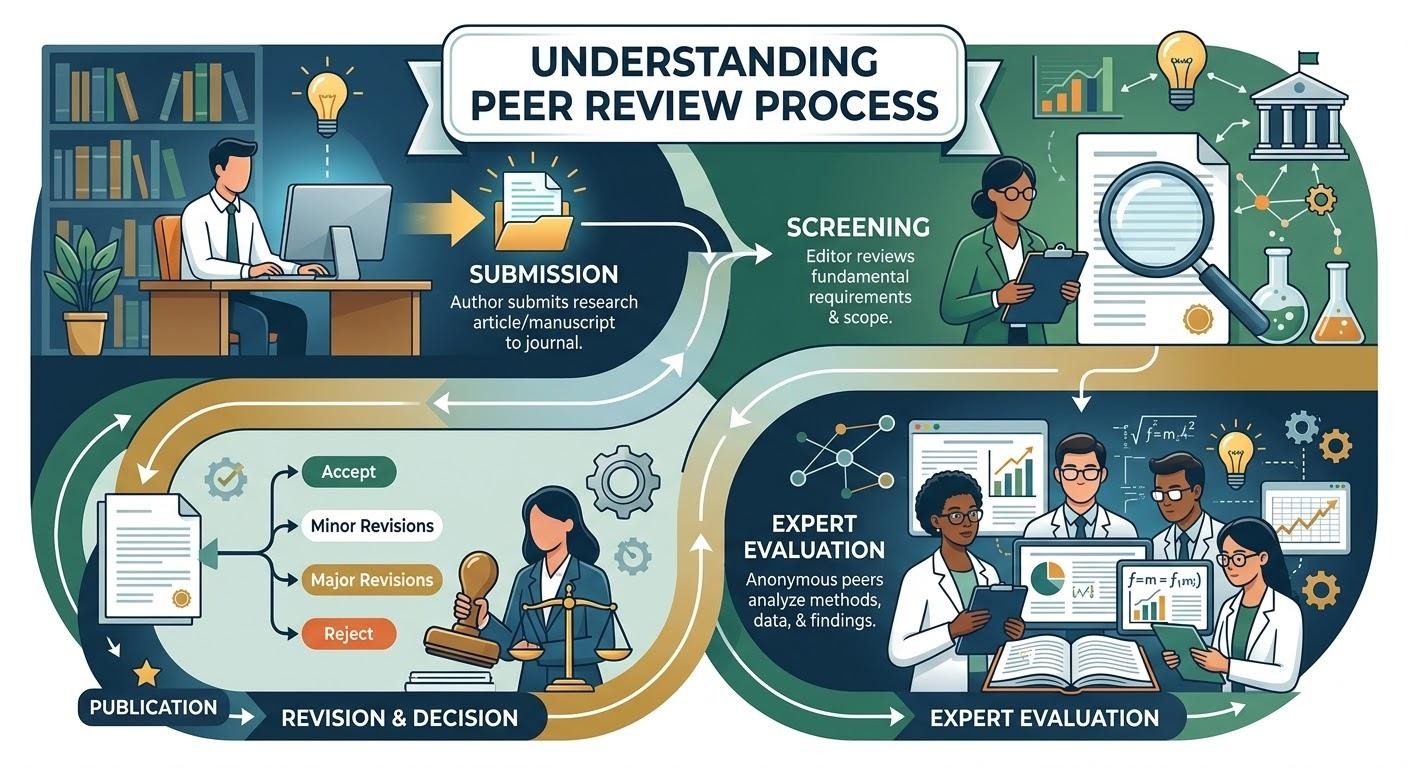
Submission: In the first step, a research article or manuscript is sent to an academic publication by an author.
-
Screening: The work is reviewed by the journal editor to determine whether it satisfies the publication's fundamental quality requirements and scope.
-
Expert Evaluation: The anonymous peer reviewers analyse the study design, procedures, data, and findings.
-
Revision & Decision: Lastly, in the peer review procedure, the editor makes the final publication decision after reviewers suggest revisions, significant rewrites, or rejection.
What is the peer review process?
Peer review is a method in which experts in a particular field or domain assess and analyse research quality.
Moreover, they examine and evaluate the validity, quality and normally the originality of papers for publication. As a result, the scientific manuscript review process is the foundation for protecting the quality and integrity of academic research.
Peer Review Process Steps
Here are the steps you need to follow for how to peer review a paper or peer review.
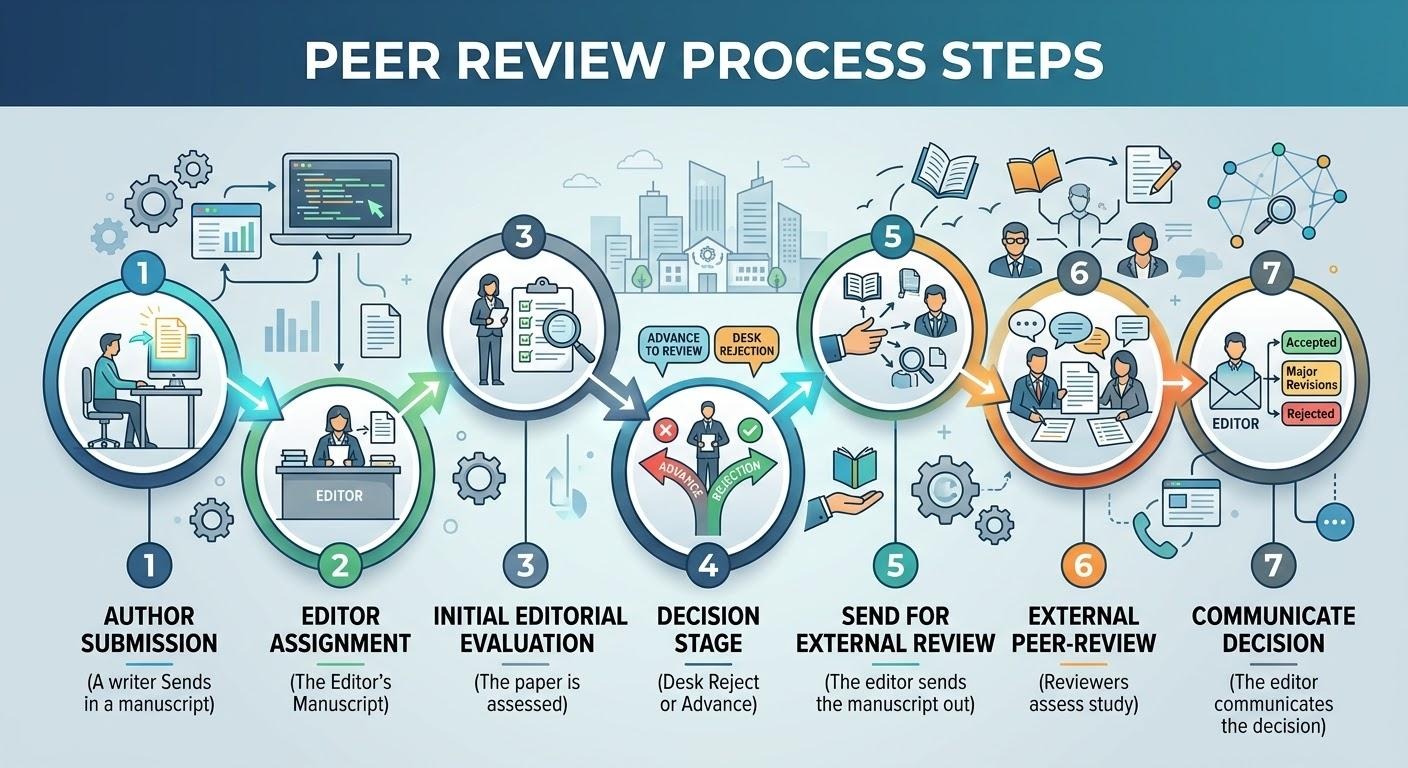
1. A writer sends in a manuscript
A journal receives the author's Manuscript Submission for possible publication.
2. The Editor's Manuscript
The journal then gives the editor the manuscript to handle the next set of submission guidelines for the manuscript.
3. Editorial Evaluation
The designated editor then assesses the paper to determine whether it meets the journal's standards. and whether it meets the peer-review requirements.
4. Decision Stage: Reject or Advance
After the initial editorial process of evaluation, the editor decides whether to desk reject the manuscript or send it for external peer review.
Desk Rejection
If the manuscript does not meet the requirements for consideration, the paper is desk rejected. This means the manuscript will not undergo any additional stages and will be returned to the author with an explanation of the decision.
5. Send the Manuscript for Review
The editor sends the manuscript out for external Journal Peer Review by inviting at least two reviewers qualified in the field covered by the article.
They can be both academic researchers and professionals from related industries. Both reviewers should submit a report to the editor with their comments and recommendations regarding the manuscript
6. External Peer-Review
Depending on the comments received, the editor decides whether to accept the manuscript for publication, reject it, or request additional revisions.
Usually, the editors may ask the author to make revisions to the work.
In that case, they should specify what changes to make and what questions to answer.
Additionally, the editor may ask peer reviewers to revise or add parts of their report if they consider it necessary based on the paper's content.
7. Communicate the Decision to the Author and Reviewers
In the final step, the editor communicates the decision to the author along with the peer-review reports. All accepted manuscripts are published in the following issues of the Journal Editorial Process.
Are you still having issues in your peer review practice?
Expert golf journal publishers offer a diverse range of top-notch publishing services at a reasonable price.!
Hurry up and engage now!
The Role of an Editor in a Peer Review
Researchers have recently highlighted issues in improving peer review efficiency when selecting scholarly papers for publication.
Two key people in the peer review process are authors and peer reviewers. However, the role of editors play a huge role by handling the process and holding those who are connected to the process.
Here are the key roles of the editorial workflow for academic journals.
-
Evaluates suitability- Is the paper sound, within scope, and above the journal's cutoff? At this point, the journal may reject unsuitable work.
-
Selects reviewers- Chooses reviewers by inviting impartial specialists with pertinent experience who don't have any conflicts of interest that would disqualify them.
-
Weighs the reports- Evaluates the reports by critically reading the reviews, settling disputes, and comparing the paper to the journal's requirements.
-
Reaches a decision- Decides whether to accept, reject, make a small or significant change, or, if necessary, recommend moving to a better journal.
Communicates clearly- Lastly, the Editorial Workflow delivers the judgement and the explanation to the writers in a clear manner.
Examples of Journaling
Here are the different examples of journaling in a peer review process.
Reflective process logs: In order to maintain objectivity and fairness in their final criticism, how reviewers are selected they record their first emotional responses to a contentious manuscript before putting the notes away.
Bias self-auditing notes: Editors or reviewers make quick notes about whether they are unjustly holding an unfamiliar approach to a higher standard than normal.
Decision audit trails: Before suggesting major changes or rejecting a proposal, reviewers document the sequence of actions and the supporting data they reviewed.
Constructive tone checks: After drafting their remarks, reviewers write a brief reflection assessing whether their wording is professional and helpful rather than harsh.
Editorial monitoring diaries: When handling difficult or contradictory reviewer disputes, journal editors maintain an ongoing record of their own chats and ideas.
Winding it Up
The most important pillar of academic integrity and high-caliber journal publishing is still the peer review process.Authors can submit with confidence if they understand how editors assess papers and handle reviewer input.
At the end of the day, adopting constructive review improves research quality and propels significant global scientific advancement.
Frequently Asked Questions
Q1: What is the main objective of the peer review process?
Prior to journal publication, the peer review process assesses research manuscripts for validity, originality, and general quality.
Q2:What takes place when someone is rejected by the editing desk?
Because the work doesn't adhere to basic journal requirements, the editor rejects it before external review.
Q3: How are outside peer reviewers chosen by journal editors?
Editors welcome unbiased subject-matter experts with no conflicts of interest.
Q4: What are the main stages of reviewing a manuscript?
The key stages are initial submission, editorial screening, expert peer review, author edits, and final publication.
Q5: Can writers edit their work after it has been reviewed by peers?
Without a doubt, editors often ask writers to respond to reviewer feedback and submit revised manuscripts for approval.
Q6: What motivates reviewers to employ reflective and Best practices for peer review management?
Reviewers can audit their own prejudices, record their decision-making processes, and keep a helpful, professional tone by keeping a journal.